Learning the Korean alphabet, Hangul, is an incredibly rewarding experience. Its logical structure makes it easy for beginners to pick up the basics in just a few hours. However, as you dive deeper into reading Korean vocabulary, you will inevitably encounter a hurdle that trips up many language learners: the Korean double consonant at the bottom of a syllable.
In Korean grammar, the final consonant of a syllable block is called the Batchim (받침). While single final consonants are straightforward, the double consonants (겹받침) can look intimidating. Two letters squeezed into the bottom of one block? How do you even say that?
If you have ever stared at words like 닭 (chicken) or 읽다 (to read) and felt completely lost, you are not alone! It is completely normal to feel confused, but the reality is much simpler than it looks.
In this lesson, we are going to break down one of the most common and important double consonants: ‘ㄺ’ (Rieul-Giyeok). By the end of this guide, you will know exactly how to read it, how to write it, and how to practice it so you never mispronounce it again.
What is a Double Consonant (겹받침)?
Before we focus on ‘ㄺ’, let’s understand the basic rule of all Korean double consonants.
A double consonant consists of two different consonants sitting side-by-side at the bottom (the batchim position) of a Korean syllable block. Because the Korean language values smooth and efficient pronunciation, it is physically very difficult to pronounce two distinct consonant sounds at the end of a single syllable.
The Golden Rule of Double Consonants: Even though you see two letters, you only pronounce one of them.
The trick is simply knowing which one of the two letters gets to “speak” and which one stays silent.
Meet the Star of the Lesson: ‘ㄺ’
The double consonant ‘ㄺ’ is made up of:
- ㄹ (Rieul) – which sounds like an ‘r’ or ‘l’.
- ㄱ (Giyeok) – which sounds like a hard ‘k’ or ‘g’.
When these two letters team up at the bottom of a block, only the ‘ㄱ’ (k/g sound) is pronounced. The ‘ㄹ’ remains completely silent.
Let’s Look at the Core Vocabulary: 닭 and 흙
Let’s look at two of the most common beginner Korean words that use this batchim.
1. 닭 (Chicken)
- How it looks: ㄷ + ㅏ + ㄺ
- How it sounds: [닥] (Dak)
- Common Learner Mistakes: Because learners see the ‘ㄹ’, they often try to pronounce it as “달 (Dal)” or try to sound out both letters as “달그 (Dal-geu)”.
- The Reality: The ‘ㄹ’ is silent. Drop it completely from your speech. The correct pronunciation is simply [닥]. Keep the ‘k’ sound short and sharp.
2. 흙 (Dirt / Soil / Earth)
- How it looks: ㅎ + ㅡ + ㄺ
- How it sounds: [흑] (Heuk)
- Common Learner Mistakes: Do not say “흘 (Heul)” and do not say “흘그 (Heul-geu)”.
- The Reality: Again, drop the ‘ㄹ’. The correct pronunciation is [흑].
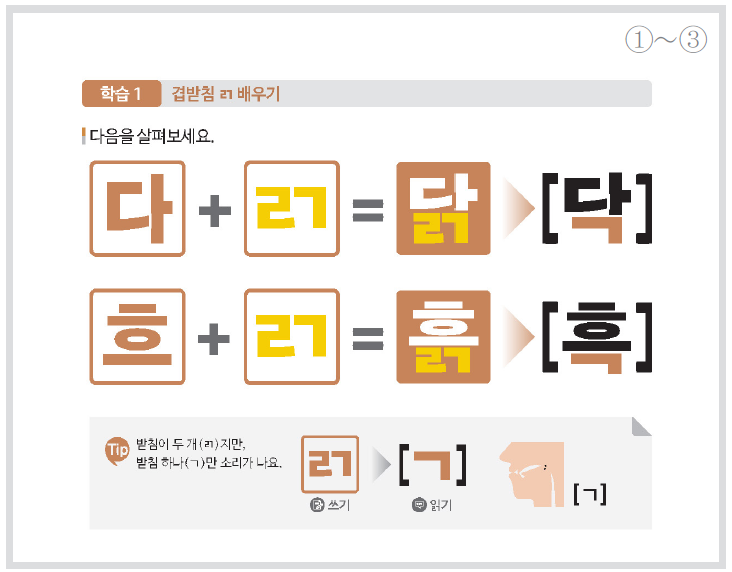
Teacher’s Tip: Try saying them out loud right now. “Dak.” “Heuk.” Keep your jaw slightly tight at the end of the word to cut off the airflow. That is the perfect Korean batchim sound!
How to Write ‘ㄺ’ Properly
Writing Hangul correctly helps solidify the characters in your muscle memory. The rule for writing Korean is always Left to Right, Top to Bottom.
When writing the ‘ㄺ’ batchim underneath a vowel:
- First, write the ㄹ (Rieul) on the left side.
- Second, write the ㄱ (Giyeok) snugly on the right side.
Make sure they fit nicely next to each other within the imaginary square of the syllable block.
The “Next Consonant” Rule (Tensification / 경음화)
Now that you know how to pronounce nouns like 닭 (chicken), what happens when we look at Korean verbs or adjectives? This introduces a very common Korean pronunciation rule called Tensification (경음화).
Look at the beginner vocabulary word for “to read”:
- 읽다 (To read)
Based on our rule, you know that the first block “읽” is pronounced as [익] (Ik). But what happens to the “다” (da) that comes next?
When the hard ㄱ (k) sound meets the soft ㄷ (d) sound, they clash. To make the pronunciation flow naturally, the Korean language makes the second consonant stronger (tense).
The Rule: ㄱ + ㄷ → [ㄸ]
Therefore, when you say “to read” out loud, the pronunciation changes:
- Spelling: 읽다
- Actual Pronunciation: [익따] (Ik-tta)
Another Example:
- 밝다 (To be bright)
- Actual Pronunciation: [박따] (Bak-tta)
You do not need to memorize complicated linguistic jargon. Just remember: when ‘ㄺ’ is followed by ‘다’, the ‘다’ sounds harder, like a double ‘ㄸ’. Keep your focus on the sound, rather than overthinking the science behind it!
(Note: What happens if a vowel comes directly after the ‘ㄺ’? For example, 읽 + 어요? This causes a different rule called “Liaison” (연음), where both letters make a sound! But don’t worry about that today. Focus on mastering the basic consonant sounds first.)
Visual Vocabulary List for Beginners
Here is a quick vocabulary list featuring the ‘ㄺ’ batchim. To study effectively, try searching for images of these words to build a visual connection in your brain.
| Korean Word | Meaning | Pronunciation to Practice |
| 닭 | Chicken | [닥] (Dak) |
| 흙 | Dirt / Soil | [흑] (Heuk) |
| 읽다 | To read | [익따] (Ik-tta) |
| 밝다 | To be bright | [박따] (Bak-tta) |
| 맑다 | To be clear (weather/water) | [막따] (Mak-tta) |
| 찜닭 | Braised chicken (Korean dish) | [찜닥] (Jjim-dak) |
Cultural Note: “찜닭” (Jjimdak) is a delicious traditional Korean dish made of braised chicken, vegetables, and glass noodles in a savory soy-based sauce. Next time you visit a Korean restaurant, try ordering it! You now know exactly how to pronounce it.
Hands-On Practice Methods
Reading a blog post is great, but actively practicing is how you achieve fluency. Here are two highly effective, teacher-approved methods to master the ‘ㄺ’ double consonant.
Method 1: The “Self-Correction” Flashcard System
Create physical or digital flashcards (using apps like Anki or Quizlet).
- On the Front: Write the Korean word (e.g., 닭) and include a picture or drawing of the item. Do not put English translations on the front.
- On the Back: Write the exact phonetic pronunciation block (e.g., [닥]) and the English meaning.
- How to use: Look at the front, say the word out loud, and immediately flip it over to check your pronunciation. If you accidentally say the “ㄹ”, put the card in the “needs review” pile.
Method 2: The Word-Finding Game (Great for Study Groups!)
If you are learning with a friend or a study group, try this fast-paced game:
- Preparation: Create multiple sets of index cards with different words written on them (use words with ‘ㄺ’, alongside other words like 달, 학, etc.).
- The Game: Spread the cards out on a table. One person (or the teacher) calls out the exact pronunciation—for example, “[막따]!”
- The Goal: The other players must race to find and slap the correct written spelling card (맑다).
- Why it works: This forces your brain to quickly connect the spoken sound to the correct spelling, bridging the gap between listening and reading.
Frequently Asked Questions (FAQ)
Q: Do I really need to learn double consonants right away?
Yes! While it may seem like an advanced topic, words like “닭” (chicken) and “읽다” (to read) are beginner-level vocabulary. Learning the rules early will save you from developing bad pronunciation habits.
Q: Why does Korean have double consonants if only one is pronounced?
Hangul is a highly historical alphabet. Hundreds of years ago, Koreans may have actually pronounced both sounds! As the language evolved and modernized, speech naturally became faster, and dropping one of the consonants made speaking much easier. The spelling was kept to preserve the root meaning of the word.
Q: Is the ‘ㄹ’ in ‘ㄺ’ always silent?
It is silent when it sits at the end of a word or is followed by another consonant. However, if a vowel directly follows it (like in 읽어요 – “I read”), the ‘ㄹ’ stays at the bottom, and the ‘ㄱ’ moves over to the vowel. So, “읽어요” is pronounced [일거요] (il-geo-yo). We will cover this fully in a future lesson on Korean linking sounds!
Summary
Learning Korean pronunciation takes patience, but you are making excellent progress by tackling the hard concepts head-on. Remember these key takeaways:
- When you see ‘ㄺ’, drop the ‘ㄹ’ and only pronounce the hard ‘ㄱ’ (k/g).
- 닭 is [닥]. 흙 is [흑].
- When followed by a ‘다’ (like in verbs), the ‘다’ sounds harder: 읽다 becomes [익따].
Take out a piece of paper right now, write down the vocabulary list from this post, and say them out loud three times. You’ve got this!