If you have started your journey to learn Korean, you have probably fallen in love with the logical brilliance of the Korean alphabet, Hangul. It is beautifully designed and easy to pick up. However, just when you think you have mastered reading, you encounter a word with two consonants squished together at the bottom of a syllable block.
Welcome to the world of Korean double consonants (겹받침 – gyeop-batchim).
Seeing words like 여덟 (eight) or 싫다 (to dislike) can make any beginner freeze. How do you pronounce two letters at once? Do you say them both?
First, take a deep breath. It is completely normal to feel a bit confused by these! In this beginner-friendly Korean pronunciation guide, we are going to break down two of the most common double consonants: ‘ㄼ’ (rieul-bieup) and ‘ㅀ’ (rieul-hieut). By the end of this lesson, you will be reading these tricky words with total confidence.
The Golden Rule of Korean Double Consonants
Before we look at specific letters, you need to know the most important rule about reading double bottom consonants in Korean:
Even though there are two consonants written, you usually only pronounce ONE of them.
That’s right! You do not need to perform linguistic gymnastics to combine a ‘B’ and an ‘L’ sound simultaneously. Your job is simply to learn which of the two letters is silent and which one does the talking.
For both ‘ㄼ’ and ‘ㅀ’, the winner is the first letter: ㄹ (L/R sound).
Deep Dive: The ‘ㄼ’ (Rieul-Bieup) Consonant
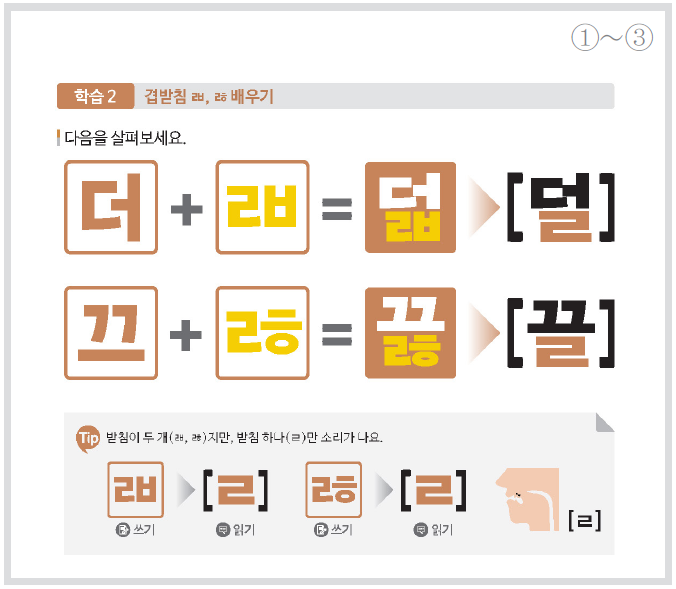
Let’s start with ‘ㄼ’. This consonant cluster is made up of ㄹ (rieul) and ㅂ (bieup).
How to Write It
When writing Hangul, always move from left to right, and top to bottom.
- First, write the ㄹ.
- Then, write the ㅂ right next to it in the bottom position (batchim) of the syllable block.
How to Pronounce It
When ‘ㄼ’ sits at the bottom of a syllable at the end of a word, or before another consonant, the ㅂ is silent. You only pronounce the ㄹ.
Let’s look at the word for “eight” in Korean: 여덟.
- Correct Pronunciation: [여덜] (Yeo-deol)
- Common Beginner Mistakes: Do not pronounce the ㅂ. It is not “yeo-deob” (X), and you should never add an extra vowel sound at the end like “yeo-deol-beu” (X).
Watch Out for “Tensing” (경음화)
Korean pronunciation rules are heavily focused on making speech flow smoothly. Sometimes, the silent ‘ㅂ’ in ‘ㄼ’ ghosts its way into the next syllable, making the following consonant sound stronger or “tensed.”
Let’s look at the word 짧다 (to be short).
Because of the hidden ‘ㅂ’, the soft ‘ㄷ’ (da) in ‘다’ becomes a hard, tense ‘ㄸ’ (tta) sound. You don’t need to memorize complex linguistic terms; just memorize the final sound.
| Korean Word | Meaning | How it is Written | How it is Pronounced |
| 여덟 | Eight | 여덟 | [여덜] (yeo-deol) |
| 짧다 | To be short | 짧 + 다 | [짤따] (jjal-tta) |
| 넓다 | To be wide | 넓 + 다 | [널따] (neol-tta) |
| 얇다 | To be thin | 얇 + 다 | [얄따] (yal-tta) |
Tip for self-study: When practicing, say the pronunciation brackets [짤따] out loud, not the written spelling!
Deep Dive: The ‘ㅀ’ (Rieul-Hieut) Consonant
Next up is ‘ㅀ’, a combination of ㄹ (rieul) and ㅎ (hieut).
How to Write It
- First, write the ㄹ.
- Then, write the ㅎ right next to it.
How to Pronounce It
Just like our previous letter, you only pronounce the ㄹ. The ㅎ is silent… mostly.
Let’s look at a standalone example. If you see the syllable 끓, it is simply pronounced as [끌] (kkeul).
- Common Beginner Mistakes: Do not try to make a ‘T’ sound at the end like “kkeut” (X), and do not add an extra breathy syllable like “kkeul-heu” (X).
The Magic Trick: “Aspiration” (격음화)
While the ㅎ (H sound) is silent, it has a superpower in the Korean language. When a weak consonant like ‘ㄷ’ comes right after an ‘ㅎ’, they combine like magic to create a strong, breathy consonant. This is called aspiration.
Here is the simple math you need to remember for reading ‘ㅀ’:
ㅎ + ㄷ = [ㅌ] (H + D = T)
Let’s look at the word 끓다 (to boil). You pronounce the ‘ㄹ’, but the hidden ‘ㅎ’ merges with the ‘다’ to create a ‘타’ (ta) sound!
| Korean Word | Meaning | How it is Written | How it is Pronounced |
| 끓다 | To boil | 끓 + 다 | [끌타] (kkeul-ta) |
| 싫다 | To dislike/hate | 싫 + 다 | [실타] (shil-ta) |
| 뚫다 | To pierce/punch | 뚫 + 다 | [뚤타] (ttul-ta) |
| 잃다 | To lose | 잃 + 다 | [일타] (il-ta) |
Instead of getting bogged down by the grammar rules, just remember that when ‘ㅀ’ meets ‘다’, it sounds like [~ㄹ타].
Fun Ways to Practice Double Consonants
Reading about Korean pronunciation rules is one thing, but muscle memory is what will make you fluent. Here are two highly effective study methods to help you master ㄼ and ㅀ.
1. The 3-Sided Flashcard Method
Create flashcards specifically for these tricky vocabulary words.
- Front: Write the Korean word (e.g., 얇다) and draw a simple picture or print an image (e.g., a thin book). Using visuals helps bypass English translation!
- Back: Write the phonetic pronunciation bracket (e.g., [얄따]) and the English meaning.When you review them, look at the picture and say the pronunciation bracket out loud before checking the back.
2. The Word Hunt Game (Great for Study Groups!)
If you have a Korean language exchange partner or a study group, try this game:
- Create a set of word cards with vocabulary using ㄼ, ㅀ, and regular single batchim words. Spread them on a table.
- Have one person (or your teacher) call out the pronunciation of the word (e.g., “실타!”).
- The players must race to find and grab the correctly spelled word card (싫다).
- The person with the most cards at the end wins! This trains your brain to connect spoken sounds to written Hangul instantly.
Important Pro-Tips for Beginners
Before you go, keep these final tips in mind as you continue to learn Korean:
- Don’t overthink the grammar right now. At a beginner level, your goal is sound recognition. Don’t spend hours analyzing why “tensing” happens. Just accept that 짧다 sounds like [짤따] and memorize it as a chunk.
- Beware of the Vowel Rule (Liaison). Everything we learned today applies when the double consonant is followed by a consonant. But what happens if it is followed by a vowel? (For example, 짧아요 – It is short).
- Sneak peek: When a vowel follows, the second letter wakes up! The ‘ㅂ’ moves over to the empty vowel space. So 짧아요 becomes [짤바요] (jjal-ba-yo). We will cover this “liaison” rule in a future lesson, but keep an ear out for it!
Learning how to read Korean double consonants takes a little bit of patience, but once you understand the hidden rules behind words like 여덟 and 싫다, reading Hangul becomes incredibly satisfying. Keep practicing your pronunciation out loud, and soon these sounds will feel completely natural.
📘 Mastering Korean Diphthongs (이중 모음) – Part 2: ㅛ and ㅠ