If you’ve already started learning basic Korean vowels, the next step is to practice them in full syllables. In Korean, vowels don’t usually stand alone. Instead, they are combined with the silent consonant ㅇ to form complete sounds.
In this guide, we’ll focus on four essential vowels: 아, 어, 오, 우. These are some of the most common sounds in Korean, and mastering them will make reading and speaking much easier.
Why Practice 아, 어, 오, 우?
These four vowels represent the core vowel sounds in Korean. They appear in thousands of everyday words. By learning them, you will:
- Understand how vowels combine with consonants
- Improve your pronunciation of basic Korean words
- Gain confidence in reading Hangul syllables
Korean Vowel 아 (ㅏ)
- Symbol: ㅏ
- Syllable form: 아
- Pronunciation: [a], like “a” in father
👉 Example words:
- 아빠 (appa, dad)
- 아기 (agi, baby)
- 사랑 (sarang, love)
💡 Tip: Notice that 아 = ㅇ + ㅏ. The “ㅇ” has no sound here. It only serves as a placeholder before the vowel.
Korean Vowel 어 (ㅓ)
- Symbol: ㅓ
- Syllable form: 어
- Pronunciation: [eo], similar to “uh” in sun
👉 Example words:
- 어머니 (eomeoni, mother)
- 영어 (yeongeo, English)
- 없어 (eopseo, not exist / don’t have)
💡 Tip: Beginners often confuse ㅓ and ㅗ. Remember:
- ㅓ = open “uh” sound
- ㅗ = rounded “o” sound
Korean Vowel 오 (ㅗ)
- Symbol: ㅗ
- Syllable form: 오
- Pronunciation: [o], like “o” in go
👉 Example words:
- 오이 (oi, cucumber)
- 오늘 (oneul, today)
- 오빠 (oppa, older brother for females)
💡 Tip: The vowel ㅗ is written to the right of ㅇ when forming 오.
Korean Vowel 우 (ㅜ)
- Symbol: ㅜ
- Syllable form: 우
- Pronunciation: [u], like “oo” in food
👉 Example words:
- 우유 (uyu, milk)
- 우리 (uri, we / our)
- 우산 (usan, umbrella)
💡 Tip: The vowel ㅜ is written below ㅇ when forming 우.
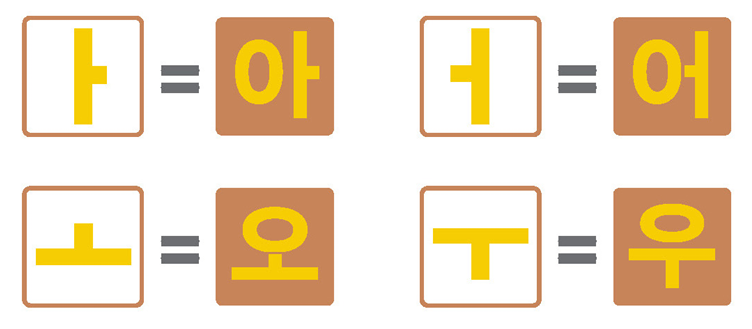
Writing Rules for Vowel Syllables
In Korean, when a syllable begins with a vowel, the silent consonant ㅇ is always added in front.
- For vertical vowels (ㅏ, ㅓ), ㅇ goes on the left.
- 아, 어
- For horizontal vowels (ㅗ, ㅜ), ㅇ goes on the top.
- 오, 우
👉 This is why “ㅏ” becomes “아” and “ㅗ” becomes “오.”
Practice Ideas
- Flashcards: Write “ㅏ” on one side and “아” on the other. Compare and practice.
- Listening drills: Play recordings of 아, 어, 오, 우 and repeat after native speakers.
- Word search game: Create a set of Korean word cards (like “아기,” “우유,” “오늘”) and match them with the correct vowel sound.
Common Mistakes to Avoid
- Confusing ㅓ (eo) and ㅗ (o) — focus on lip shape.
- Forgetting the silent ㅇ at the start of a vowel syllable.
- Mixing up stroke order when writing vowels. Remember:
- Write ㅇ first, then the vowel.
Key Takeaways
- Korean vowels combine with ㅇ to form syllables.
- 아, 어, 오, 우 are among the most common vowels in Korean words.
- Pay attention to lip shape and tongue position for accurate pronunciation.
- Practice with flashcards, listening, and writing to reinforce learning.
Next in the Series
Now that you know 아, 어, 오, 우, the next step is to learn ㅡ, ㅣ, ㅔ, ㅐ. These vowels can be tricky but are essential for reading Korean fluently.
Learn Basic Korean Vowels(1): A Beginner’s Guide to Hangul
Understanding the Principles of Hangul: A Beginner’s Guide to the Korean Alphabet
Learn Korean Vowels (3) ㅡ, ㅣ, ㅔ, ㅐ: Pronunciation and Writing Guide