Learning Korean starts with Hangul (한글), the Korean alphabet. Hangul is known for its scientific design and easy learning curve. If you’re a beginner in Korean, one of the first steps is to master the basic Korean vowels (모음). These sounds are the foundation of Korean pronunciation and will help you read, write, and speak naturally.
In this guide, you’ll learn:
- What the basic Korean vowels are
- How to pronounce them correctly
- Simple Korean words that use each vowel
- Tips for practicing and remembering them
Why Learn Korean Vowels First?
Korean vowels are the building blocks of the language. Every Korean syllable is made of at least one consonant (자음) and one vowel (모음). Without vowels, you can’t form complete sounds.
By practicing vowels first, you’ll:
- Improve your pronunciation
- Read Hangul more easily
- Build confidence when learning Korean words
The 10 Basic Korean Vowels
In Korean, there are 21 vowels in total (10 simple vowels + 11 complex vowels). But as a beginner, you only need to focus on the basic 10 vowels:
- ㅏ [a] — as in “father”
- ㅓ [eo] — similar to “uh” in “sun”
- ㅗ [o] — as in “go”
- ㅜ [u] — as in “food”
- ㅡ [eu] — a unique Korean sound, between “oo” and “uh”
- ㅣ [i] — as in “see”
- ㅔ [e] — as in “bed”
- ㅐ [ae] — similar to “cat”
- ㅚ [oe] — like “we” in “west”
- ㅟ [wi] — as in “week”
👉 Tip: Focus on the first 8 vowels (ㅏ, ㅓ, ㅗ, ㅜ, ㅡ, ㅣ, ㅔ, ㅐ). These are the foundation of beginner Korean.
Step-by-Step Practice
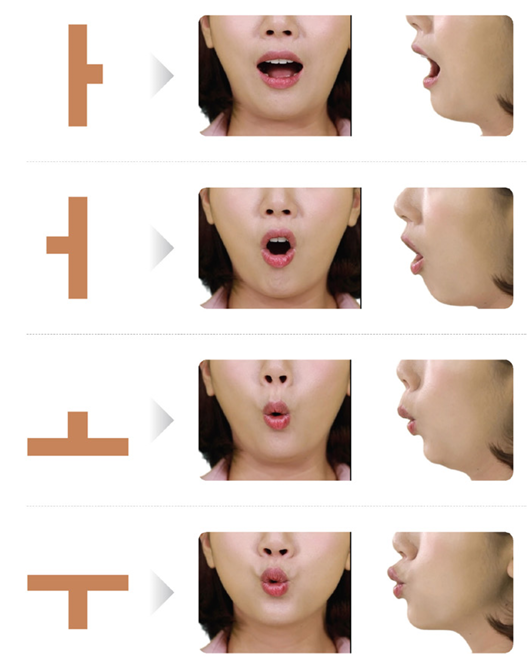
Learn ㅏ, ㅓ, ㅗ, ㅜ
- ㅏ = a (아) → “아빠” (appa, dad)
- ㅓ = eo (어) → “어머니” (eomeoni, mother)
- ㅗ = o (오) → “오이” (oi, cucumber)
- ㅜ = u (우) → “우유” (uyu, milk)
👉 Practice tip: Compare ㅗ and ㅜ. ㅗ is pronounced with lips slightly rounded forward, while ㅜ requires tighter, rounded lips.
Learn ㅡ and ㅣ
- ㅡ = eu (으) → unique sound, no direct English match
- ㅣ = i (이) → “이름” (ireum, name)
👉 Practice tip: Try alternating between “ㅡ” and “ㅣ” to train your tongue position.
Learn ㅔ and ㅐ
- ㅔ = e (에) → “네” (ne, yes)
- ㅐ = ae (애) → “아이” (ai, child)
👉 Practice tip: These two are very similar. Listening to native speakers is the best way to notice the difference.
Compare Vowels (Pronunciation Drill)
- ㅓ vs. ㅗ → (어 vs. 오)
- ㅡ vs. ㅜ → (으 vs. 우)
- ㅔ vs. ㅐ → (에 vs. 애)
👉 Practice tip: Record your voice and compare it with native Korean speakers on YouTube or language apps.
Fun Practice Ideas
- Word Cards: Write a vowel on one side and a word on the other. Practice flipping and reading.
- Listening Games: Play recordings of Korean words and guess which vowel you hear.
- Writing Practice: Remember the stroke order: write from top to bottom, left to right.
Key Takeaways
- Start with the basic vowels (ㅏ, ㅓ, ㅗ, ㅜ, ㅡ, ㅣ, ㅔ, ㅐ).
- Practice with simple Korean words to improve recognition.
- Focus on pronunciation differences between similar vowels.
- Use repetition, listening, and writing to make learning fun.
Ready to Learn More Korean?
Mastering Korean vowels is the first step to fluency. Once you’re comfortable with these sounds, you’ll be ready to learn Korean consonants, syllable blocks, and start forming full Korean sentences.
Understanding the Principles of Hangul: A Beginner’s Guide to the Korean Alphabet
Learn Korean Vowels (2) 아, 어, 오, 우: Pronunciation and Writing Guide
Learn Korean Vowels (3) ㅡ, ㅣ, ㅔ, ㅐ: Pronunciation and Writing Guide
Learn Korean Vowels (4) 으, 이, 에, 애: A Beginner’s Guide to Hangul