Learning Korean pronunciation can be exciting yet challenging, especially when it comes to consonants. Among the most important sounds for beginners to master are the aspirated consonants, known in Korean as 격음 (gyeogeum). These sounds are stronger and breathier than their plain counterparts.
In this three-part series, we will guide you step by step through Korean aspirated consonants. In Part 1, you will learn how to recognize, pronounce, and practice the first group: ㅋ (k), ㅌ (t), and ㅍ (p).
What Are Aspirated Consonants in Korean?
In Korean, some consonants are pronounced with an extra burst of air. These are called aspirated sounds. For example, compare the English sounds in “pin” vs. “spin.” In “pin,” you feel a puff of air when you release the p, but in “spin,” the air is softer.
Korean makes this distinction more systematically. The aspirated consonants are:
- ㅋ (k sound with a strong breath)
- ㅌ (t sound with a strong breath)
- ㅍ (p sound with a strong breath)
- ㅊ (ch)
- ㅎ (h)
This article focuses on the first three: ㅋ, ㅌ, and ㅍ.
Learning the Sound of ㅋ (Kieuk)
The consonant ㅋ is similar to an English k but with a stronger breath. To practice:
- Combine ㅋ with the vowel ㅏ (a) → 카 [ka]
- Combine ㅋ with the vowel ㅗ (o) → 코 [ko]
👉 Try saying them aloud: ka, ko.
Place your hand in front of your mouth—you should feel a strong puff of air.
Example Words with ㅋ
- 코 [ko] – nose
- 스키 [seuki] – ski
- 카메라 [kamera] – camera
- 케이크 [keikeu] – cake
Learning the Sound of ㅌ (Tieut)
The consonant ㅌ sounds like an English t, but with more forceful air. To practice:
- 타 [ta] (ta)
- 토 [to] (to)
👉 Repeat several times: ta, to.
Your tongue should touch the ridge behind your upper teeth, then release with a burst of air.
Example Words with ㅌ
- 토마토 [tomato] – tomato
- 타조 [tajo] – ostrich
- 기타 [gita] – guitar
- 오토바이 [otobai] – motorcycle
Learning the Sound of ㅍ (Pieup)
The consonant ㅍ is like an English p, but again with stronger breath. To practice:
- 파 [pa] (pa)
- 포 [po] (po)
👉 Repeat several times: pa, po.
Press your lips together tightly, then release them with a strong puff of air.
Example Words with ㅍ
- 피아노 [piano] – piano
- 포도 [podo] – grape
- 피자 [pija] – pizza
- 포크 [pokeu] – fork
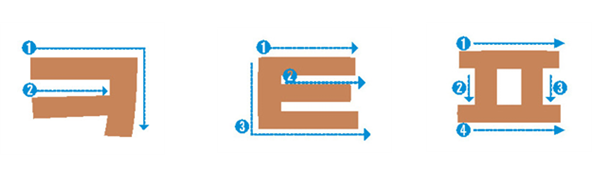
Writing Practice: Stroke Order
Learning how to write these consonants is as important as pronouncing them. Follow the correct stroke order:
- ㅋ: write the vertical stroke first, then the two horizontal lines.
- ㅌ: similar to ㅁ but with an extra horizontal stroke at the top.
- ㅍ: two horizontal lines with a vertical line in the middle.
👉 Remember: Korean is written top to bottom and left to right.
Pronunciation Tips
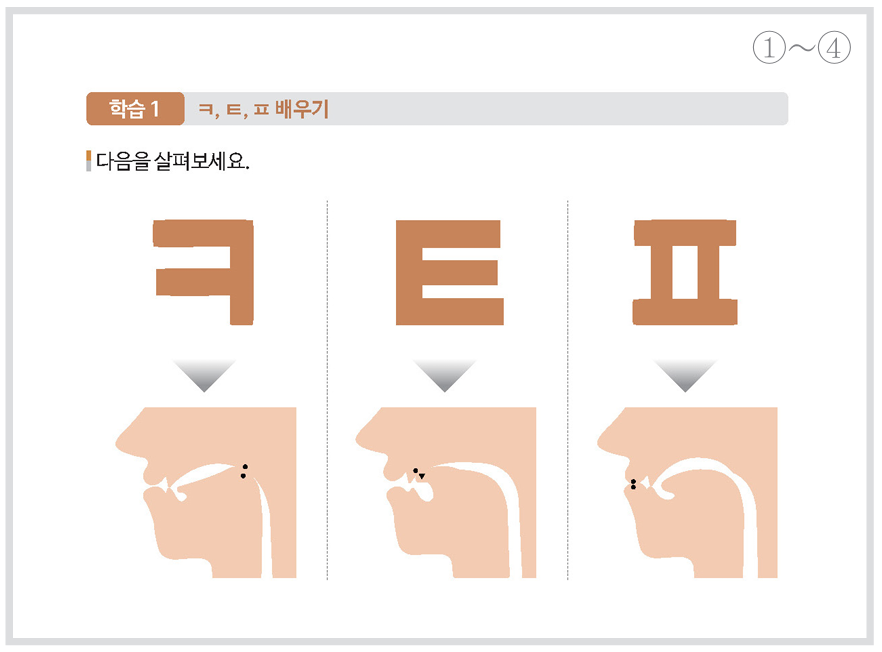
- ㅋ: Made by blocking airflow at the back of the mouth, then releasing it with a burst.
- ㅌ: Made with the tongue against the alveolar ridge (just behind the upper teeth).
- ㅍ: Made with both lips pressed together, then released with strong breath.
Aspirated consonants are always stronger than their plain counterparts:
- ㄱ (soft g/k) → ㅋ (hard k)
- ㄷ (soft d/t) → ㅌ (hard t)
- ㅂ (soft b/p) → ㅍ (hard p)
Fun Practice Activities
Here are some simple activities you can try at home or in the classroom:
📌 Word Card Reading
- Write words like 코, 토마토, 포도 on flashcards.
- Practice reading them aloud.
- Check your pronunciation by listening to native speakers online.
📌 Minimal Pairs
Compare aspirated vs. plain consonants:
- 고 [go] vs. 코 [ko]
- 도 [do] vs. 토 [to]
- 보 [bo] vs. 포 [po]
👉 Can you hear and feel the difference?
📌 Dictation Relay
- Have a partner read a word with ㅋ, ㅌ, or ㅍ.
- Write down what you hear.
- Switch roles. This game trains listening and writing together.
Common Mistakes to Avoid
- Forgetting the puff of air – Many learners pronounce ㅋ, ㅌ, ㅍ too softly, making them sound like ㄱ, ㄷ, ㅂ.
- Confusing spelling – Remember that vowels like ㅏ, ㅓ, ㅣ, ㅔ, ㅐ are written to the right of consonants, while vowels like ㅗ, ㅜ, ㅡ are written below.
- Using Romanization only – Relying too much on English letters (like “ka, ta, pa”) can limit your progress. Always practice with actual Hangul.
Summary: ㅋ, ㅌ, ㅍ
- ㅋ = Strong K sound (like k in “kite” but breathier).
- ㅌ = Strong T sound (like t in “top” but breathier).
- ㅍ = Strong P sound (like p in “pie” but breathier).
Practice them with vowels:
- 카, 코 / 타, 토 / 파, 포
And remember to use real Korean words for practice:
- 코 (nose), 토마토 (tomato), 피아노 (piano), 포도 (grape).
What’s Next?
This is Part 1 of the Korean Aspirated Consonant Series.
In the next lesson, we will explore ㅊ (ch) and ㅎ (h), which also belong to the aspirated consonant family. These sounds have unique rules and appear often in everyday Korean words.
👉 Stay tuned for Part 2: Learning ㅊ and ㅎ in Korean.
Final Thoughts
Mastering ㅋ, ㅌ, and ㅍ is a key step in sounding natural when speaking Korean. With steady practice, you will clearly distinguish between aspirated and plain consonants, making your Korean much more understandable.
💡 Pro tip: Always practice with real words, not just isolated sounds. That way, you train both your pronunciation and vocabulary at the same time.
Keep practicing, and you’ll soon find yourself saying 카메라, 토마토, and 피아노 with confidence!
Understanding the Principles of Hangul: A Beginner’s Guide to the Korean Alphabet
Learn Korean Vowels (2) 아, 어, 오, 우: Pronunciation and Writing Guide
Learn Korean Vowels (4) 으, 이, 에, 애: A Beginner’s Guide to Hangul
Learn Korean Consonants (1): ㄴ, ㅁ, ㄹ (Ni-eun, Mi-eum, Ri-eul) – Beginner’s Guide