If you’re learning Korean, congratulations—you’ve reached the final step of mastering the basic consonants! In this lesson, we’ll learn two important Korean consonants: ㅅ (S) and ㅈ (J). These sounds are common in everyday words, so practicing them well will help you read, write, and speak Korean more naturally.
How to Pronounce ㅅ (S)
The Korean consonant ㅅ is similar to the English “s.”
- When combined with vowels, it makes simple syllables:
- ㅅ + ㅏ = 사 (sa)
- ㅅ + ㅗ = 소 (so)
👉 Try repeating after the examples: 사, 소
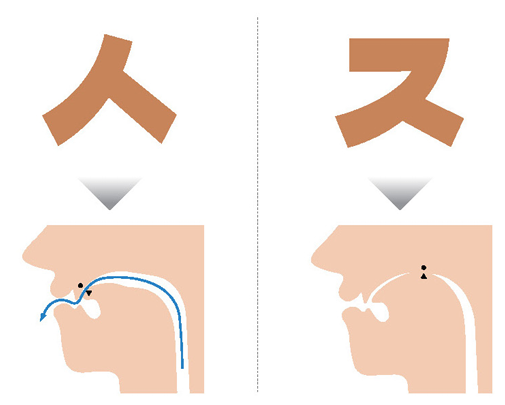
📌 Pronunciation tip: Place the tip of your tongue lightly behind your lower teeth, and let the air pass through without blocking it.
How to Pronounce ㅈ (J)
The Korean consonant ㅈ is similar to the English “j” (as in “juice”).
- When combined with vowels, it forms:
- ㅈ + ㅏ = 자 (ja)
- ㅈ + ㅗ = 조 (jo)
👉 Repeat after the examples: 자, 조
📌 Pronunciation tip: Place the front of your tongue against the roof of your mouth, then release a small burst of air.
Practice with Words
Let’s practice with some beginner-friendly Korean words that use ㅅ and ㅈ:
| Korean Word | Pronunciation | Meaning |
|---|---|---|
| 사자 | sa-ja | lion 🦁 |
| 시소 | si-so | seesaw |
| 자두 | ja-du | plum |
| 조개 | jo-gae | clam 🐚 |
👉 Read each word slowly, then repeat a few times.
Writing ㅅ and ㅈ
Just like in English, stroke order matters in Korean writing. Follow these rules:
- ㅅ (S): Start from the top and draw two short diagonal lines, then add a short line at the bottom.
- ㅈ (J): Start with a short horizontal line on top, then add a vertical line with two small arms below.
✍️ Tip: Practice writing them in the air with your finger before writing on paper.
Fun Practice Activities
Here are some simple activities to make learning fun:
- Word Card Game
- Prepare cards with Korean words on one side and pictures on the other.
- Listen to the word, find the correct card, and say it out loud.
- Quick Pronunciation Challenge
- Look at a card and say the word as fast as you can.
- Play with a friend—whoever is faster wins!
These activities will help you connect sounds, letters, and meanings naturally.
Learning Tips
- Remember: Consonants in Korean cannot be pronounced alone. They always combine with vowels.
- Use clear vowels like ㅏ (a) or ㅗ (o) when practicing consonants.
- Follow the correct stroke order when writing—vertical lines go top to bottom, horizontal lines go left to right.
- Don’t rely only on Romanization (English letters). Focus on Korean sounds directly.
Wrap-Up
Now you’ve learned the last two basic Korean consonants: ㅅ (S) and ㅈ (J). 🎉
- Practice saying them with vowels (사, 소, 자, 조).
- Learn common words (사자, 시소, 자두, 조개).
- Write them correctly using the right stroke order.
With this lesson, you’ve officially completed all the basic Korean consonants! 👏 Great job!
👉 In the next stage of your Korean learning journey, you’ll explore Korean vowels, syllable blocks, and everyday vocabulary.
Keep practicing daily, and you’ll soon be able to read and speak Korean confidently!
Learn Korean Consonants (1): ㄴ, ㅁ, ㄹ (Ni-eun, Mi-eum, Ri-eul) – Beginner’s Guide
Learn Korean Consonants (2): ㄱ, ㄷ, ㅂ (Giyeok, Digeut, Bieup) – Beginner’s Guide